Food prices driving higher inflation in sub-Sahara Africa – IMF

Inflation is rising around the world. In sub-Saharan Africa, one item is driving the trend more than others: food prices. Food accounts for roughly 40 percent of the region’s consumption basket—a measure of goods and services used to measure consumer price index (CPI) inflation.
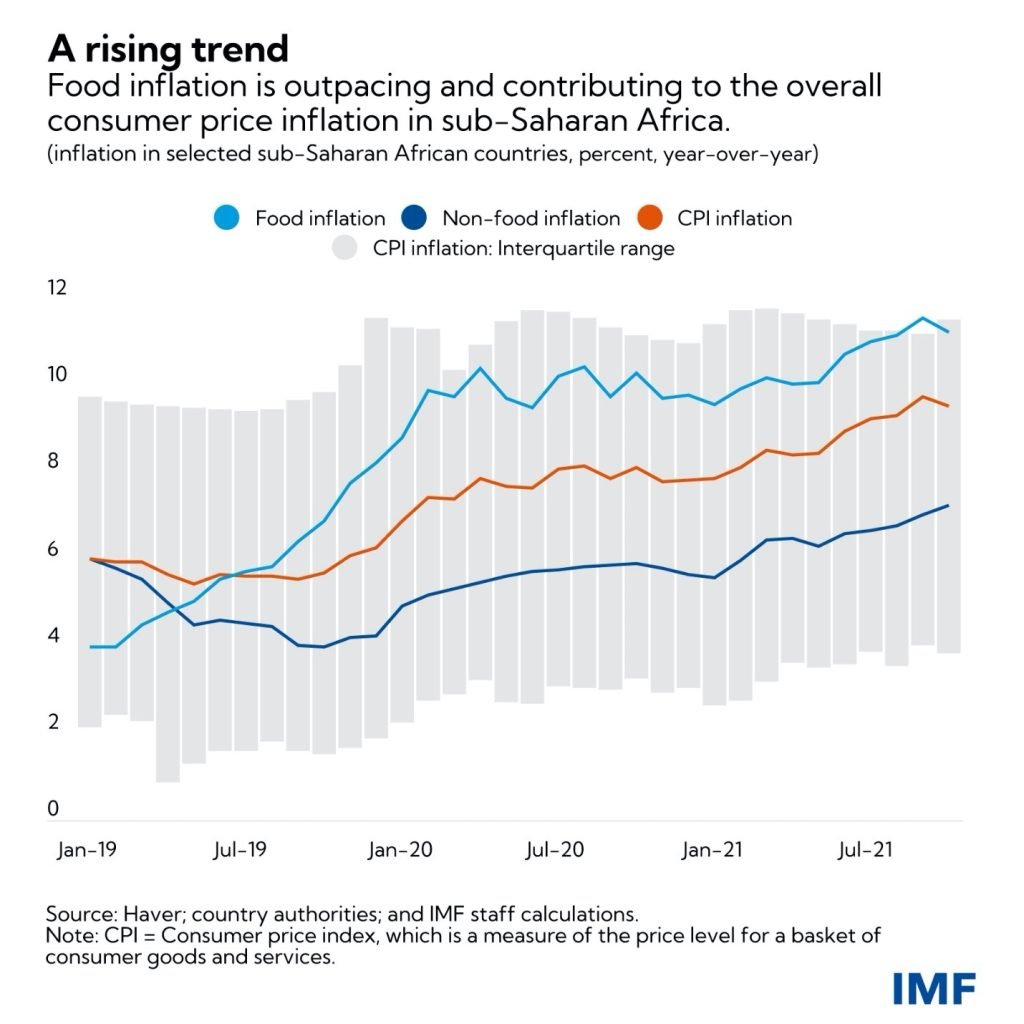
Food inflation increased throughout 2019, on average, across 20 countries in the region where monthly food price data are available. After remaining stable around 9 percent (year over year) since the beginning of the pandemic, food inflation started to rise again from April this year to some 11 percent in October.
The chart below shows how food inflation is outpacing and contributing to the pick-up in overall consumer price inflation in sub-Saharan Africa, which rose to about 9 percent in October, up from around 6 percent in 2019.
On a global scale, the recent increase in food inflation is attributed to rising oil prices (which raise fertilizer prices and transportation costs), droughts and export restrictions imposed by some major food exporters, and stockpiling in some countries. In addition, pandemic containment measures disrupted production and imports of seeds and fertilizers and caused labor shortages during planting seasons.
Importantly, there is diversity across the region—food inflation in Chad is near zero but around 30 percent in Angola. This suggests that domestic factors such as weather and exchange rates are important contributors to food inflation in sub-Saharan African countries.
The outlook is highly uncertain. Food inflation and CPI inflation could moderate if commodity prices ease and pandemic-induced global supply chain disruptions resolve. However, high food inflation could persist if inflation expectations become de-anchored or supply chain disruptions continue.
Regionwide, average inflation is expected to edge up in 2021 before easing next year depending on commodity prices and the resolution of supply-demand mismatches.
Higher food inflation would worsen the situation for the countries already facing food insecurity and shortages with a disproportional impact on poor households.
The number of undernourished persons in the region is projected to have increased by 20 percent in 2020, encompassing 264 million people.
Fighting food insecurity through targeted social assistance and insurance can help populations cope. Avoiding trade barriers and improving access to finance, seed stocks, insecticide, fertilizer, anti-erosion measures, and irrigation are also important.
Source: IMF

Related Posts
Sidney Wafula to assume role of BAT Kenya Managing Director in June
British American Tobacco (BAT) Kenya has unveiled a key executive shake-up as part of its succession strategy, naming…
 By
By
Solar Africa’s David McDonald outlines realities of South Africa’s energy market
As South Africa’s energy sector continues its post-loadshedding evolution, optimism abounds at high-level discussions, but on-the-ground realities tell…
MTN Nigeria reports ₦5.2trn in service revenue for FY 2025
MTN Nigeria Communications Plc has released its audited financial results for the year ended December 31, 2025, reporting…

Risper Genga Ohaga appointed as APA Apollo Group CEO
East African Breweries Limited (EABL) Chief Financial Officer Risper Genga Ohaga has been named Group Chief Executive Officer…





Gallery